Year · 2026–presentBy Ayush Niroula
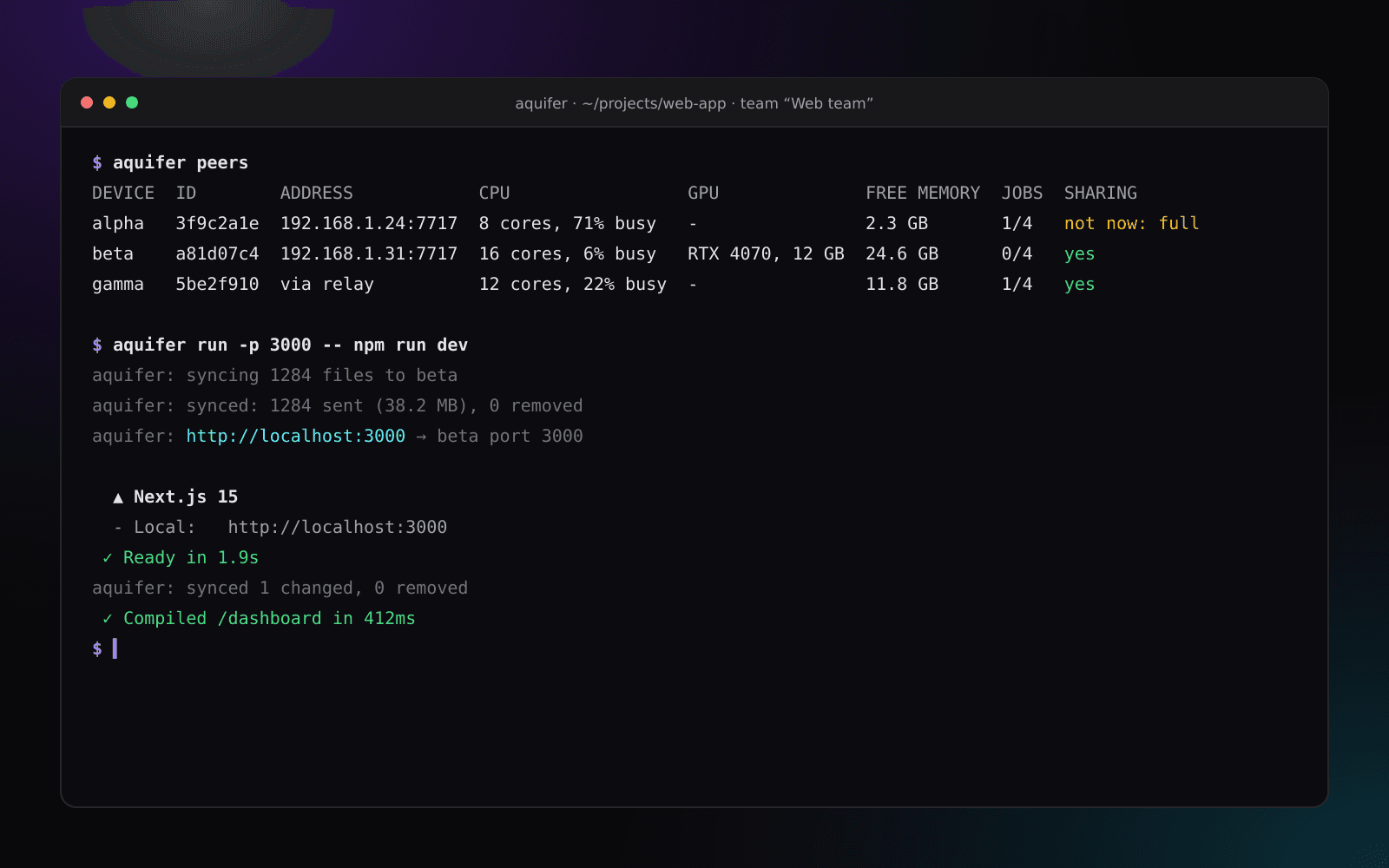
Peer-to-peer compute pooling for development teams, written in Go. Aquifer moves whole commands (a dev server, an install, a build, a test run) to a teammate's device that has spare cores and memory, syncs the project there and forwards its ports back, so localhost:3000 still works on your laptop. There is no central server: every device runs the same binary and can both share and use, with an optional self-hosted relay for teammates on other networks. Dependencies install once per lockfile, shared backends run once as team services that sleep when unused, Turborepo, Nx and npm caches are shared, test runs split into shards across devices, turbo and nx task graphs spread over the team, and GPU work lands on the device with the biggest GPU.
Highlights
- Device keys, team invites and encrypted team-only connections; the relay passes encrypted traffic it can't read
- UDP beacons signed per device and HMAC'd with the team key, with SWIM-style suspicion, indirect probes and Lifeguard local health
- Live file sync, port forwarding, env passing and real PTYs so interactive tools and Ctrl+C work remotely
- Single static binary for Linux, macOS and Windows (amd64/arm64), installable as a systemd or launchd service
Tech stack
 Go
- P2P Networking
- UDP Discovery
- SWIM Membership
- PTY
 Turborepo
- Nx
 Docker